
Vietnam lets an employer pay a probationer 85% of the job's wage and end the trial on any day without notice or compensation. Indonesia bans probation on fixed-term contracts: the clause is void, and the days worked still count as service. In the Philippines, a probationer who works past the limit becomes a regular employee by law.
How the four countries compare on probation and notice
The four laws do not even count probation in the same unit. Vietnam counts days, or working days for its lowest job tier. The Philippines and Indonesia count months. Malaysia's Act does not mention probation, so the contract decides.
Notice is more alike. In Vietnam and Malaysia, the employer and the employee owe the same length of notice. In the Philippines, the Code fixes the employee's notice at one month, while the reason for a dismissal decides what the employer owes. Indonesia sets 30 days for a resignation but 14 working days for an employer's written notice of dismissal.
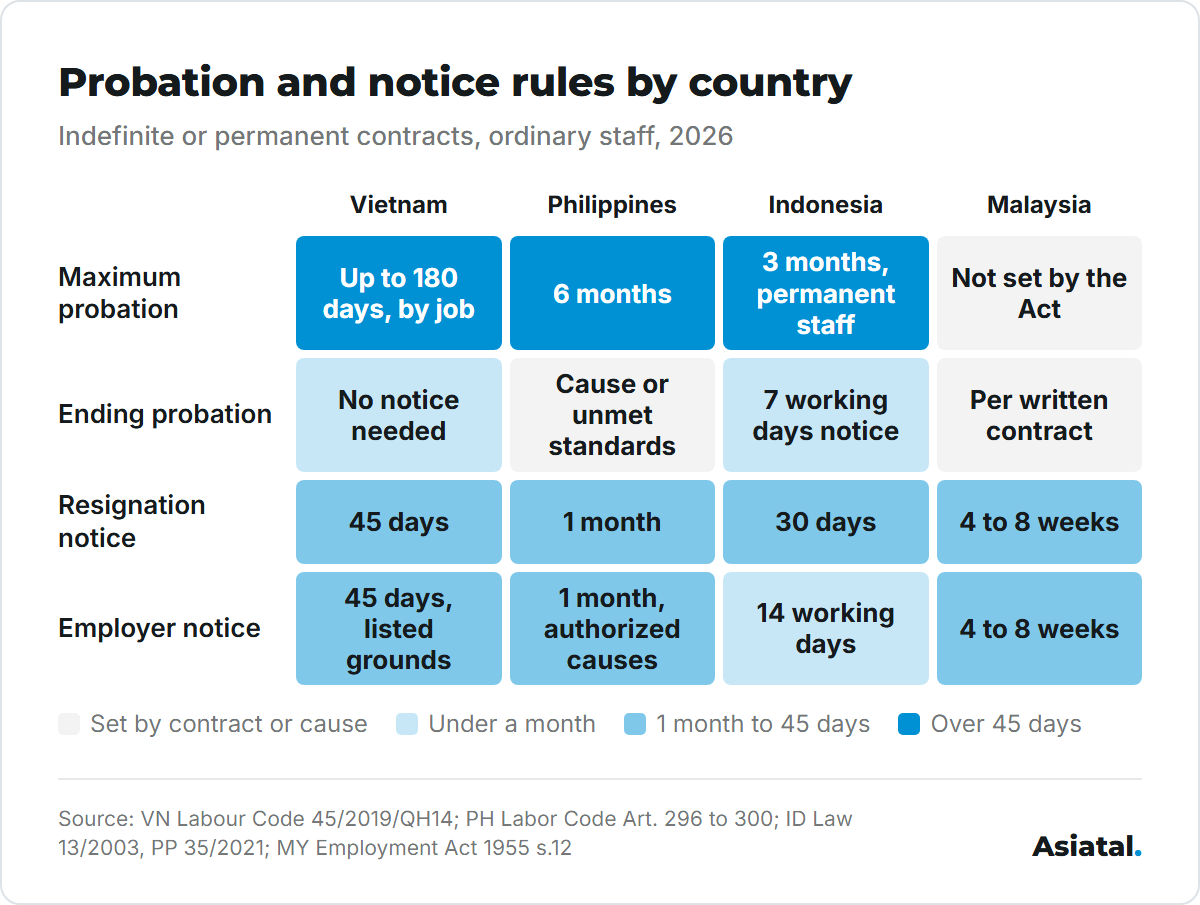
The chart covers the standard open-ended contract in each country. Fixed-term contracts follow their own rules, set out country by country below.
Buying out notice is where the four laws differ most. Of the four texts, only Malaysia's Act has a clause letting either side pay wages in place of notice.
In Vietnam, skipping notice costs the salary for the missing days. In the Philippines, an employer can sue an employee who skips it for damages. Indonesia's fixed-term rule makes the party that ends the contract early pay wages up to its end date.
Vietnam: the job sets the probation cap
A Vietnamese employer gets one probation per job, and its length depends on the qualification the job needs, not the length of the contract. Article 25 of Labour Code 45/2019/QH14 sets a cap for each of four job levels. The consolidated text published in the Official Gazette in February 2026 leaves Articles 24 to 27 unchanged.
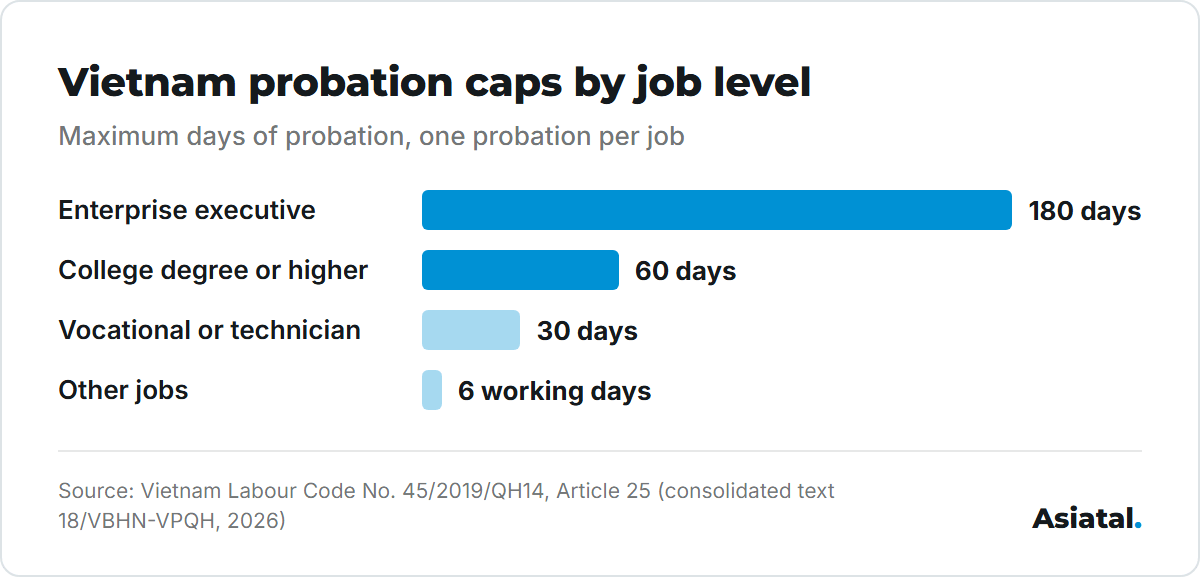
The probation terms can sit in the employment contract or in a separate probation contract (Article 24). A contract shorter than one month cannot include probation at all. At the end of the trial, the employer must tell the employee the result; during it, either side can cancel without notice or compensation (Article 27).
Notice after probation
Under Article 35, a resigning employee owes at least 45 days on an indefinite contract, 30 days on a fixed-term contract of 12 to 36 months, and 3 working days on a fixed-term contract under 12 months.
Decree 145/2020/ND-CP, Article 7 raises that to 120 days for enterprise managers, aircrew, aircraft maintenance staff and some ship crews. For those jobs on a contract under 12 months, notice is a quarter of the contract term.
An employee can leave with no notice in listed cases, such as unpaid wages, mistreatment or sexual harassment at work.
An employer's side is narrower. Article 36 lets it end a contract only on listed grounds, such as repeated failure to meet the employer's performance criteria or a long illness. The same 45, 30 and 3 day periods apply. The employer owes no notice when an employee is absent for 5 working days in a row without a valid reason.
The Code has no buyout clause. An employee who quits without the notice owes half a month's salary plus salary for the missing notice days, and loses severance allowance (Article 40). An employer that cuts the notice short pays salary for the missing days (Article 41).
An English translation of the Code is on the ILO's NATLEX database. Salary benchmarks by seniority sit on the Vietnam hiring page.
Philippines: six months, then regular by default
Article 296 of the Labor Code caps probation at six months from the first day of work. The only longer trial it allows is one written into an apprenticeship agreement.
During that time, the employer can end the job for a legal cause, or because the employee failed to meet reasonable standards. The employer must tell the employee those standards at the time of hiring.
"An employee who is allowed to work after a probationary period shall be considered a regular employee." Article 296, Labor Code of the Philippines, as renumbered by DOLE in 2015.
A regular employee has security of tenure. Under Article 294, the employer can end the job only for a just cause or an authorized cause. A worker dismissed without one can claim reinstatement and full back wages.
What each side owes
A resigning employee must give written notice at least one month ahead under Article 300. An employer that gets no notice can hold the employee liable for damages. The Code does not set a fixed sum. The employee owes no notice after serious insult, inhuman treatment or a crime by the employer against the employee or their family.
On the employer's side, there are two routes, and only one has a notice period:
- Misconduct grounds (Article 297, "just causes"): serious misconduct, gross and habitual neglect, fraud or breach of trust, a crime against the employer or its family, and similar causes. The Supreme Court held in King of Kings Transport v. Mamac (2007) that the first written notice must give at least five calendar days to answer.
- Authorized causes (Article 298): labour-saving machines, redundancy, cutting staff to prevent losses, or closure. Written notice goes to the worker and to the Department of Labor and Employment (DOLE) at least one month before, and separation pay is due.
The full renumbered text is in DOLE's 2022 edition of the Labor Code. After separation, DOLE Labor Advisory 06-20 gives the employer 30 days to release final pay and 3 days to issue a certificate of employment once asked. The Philippines hiring page lists salary benchmarks for the same roles.
Indonesia: probation exists only on permanent contracts
Indonesian law allows probation only in a PKWTT, the permanent contract. Law 13/2003, Article 60 caps it at three months and bars pay below the minimum wage during it. The Job Creation law left Article 60 in place.
It did rewrite the fixed-term rule. Law 6/2023 restates Article 58: a PKWT, the fixed-term contract, cannot require probation. If one does, the clause is void and the time still counts as service. Government Regulation 35/2021, Article 12, repeats the rule.
- Probation clause is void
- Up to 5 years including extensions
- Party ending it early pays wages to the end date
- Compensation money when the contract ends
- Probation of up to 3 months
- No end date
- Ending it follows the dismissal process
- Severance and service pay rules on dismissal
The contract details come from PP 35/2021 (Articles 8, 15 and 40) and Law 13/2003, Article 62. Constitutional Court Decision 168/PUU-XXI/2023 wrote the 5-year limit into the law itself.
Resignation and dismissal notice
A resignation needs a written request at least 30 days before the leaving date under PP 35/2021, Article 36. The employee must not be bound by a service bond and must keep working until that date.
An employer must hand over written notice of a dismissal at least 14 working days ahead, or 7 working days if the employee is on probation (Article 37). The steps after that notice changed with the 2024 court ruling.
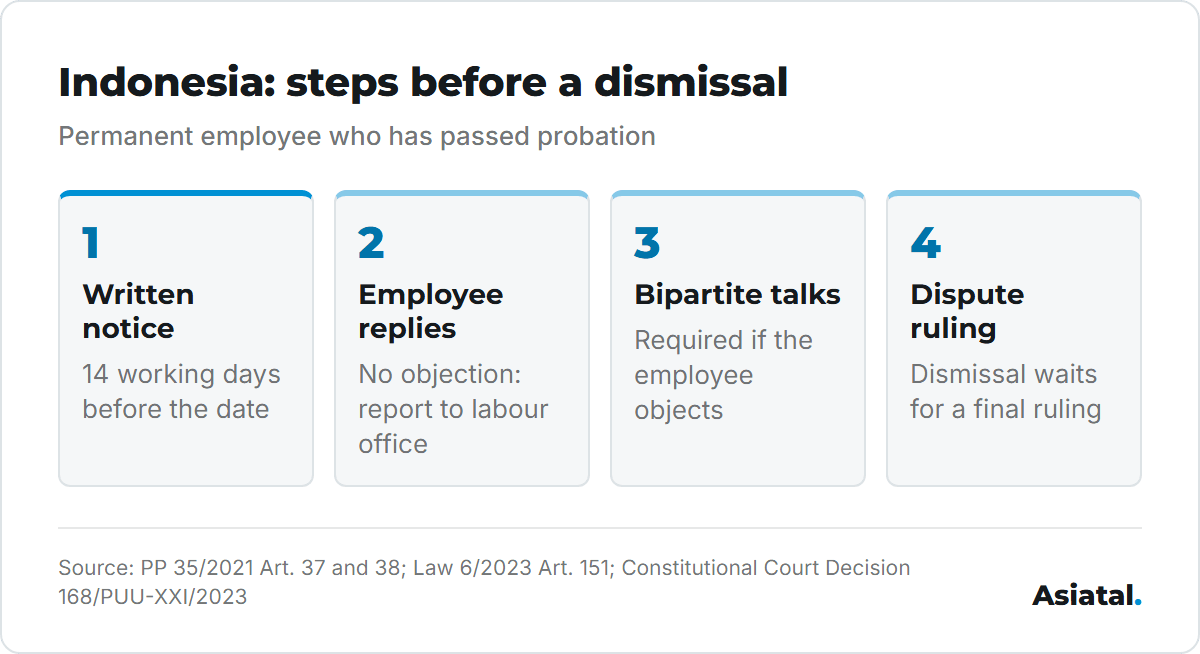
If the employee accepts, the employer reports the dismissal to the labour office (Article 38). If the employee objects, both sides must negotiate. The court read Article 151 to say that, without agreement, a dismissal can only happen once the dispute body's ruling is final.
Salary benchmarks for Indonesian roles are on the Indonesia hiring page.
Malaysia: the contract sets notice, the Act fills the gap
The word "probation" does not appear in the Employment Act 1955, in the updated text the Labour Department publishes. Any probation period, and the notice that applies during it, comes from the written contract.
Section 12 sets the notice rules. Notice must be the same length for both sides. A written notice clause in the contract decides the length. Without one, the minimum depends on the employee's service on the day of the notice.
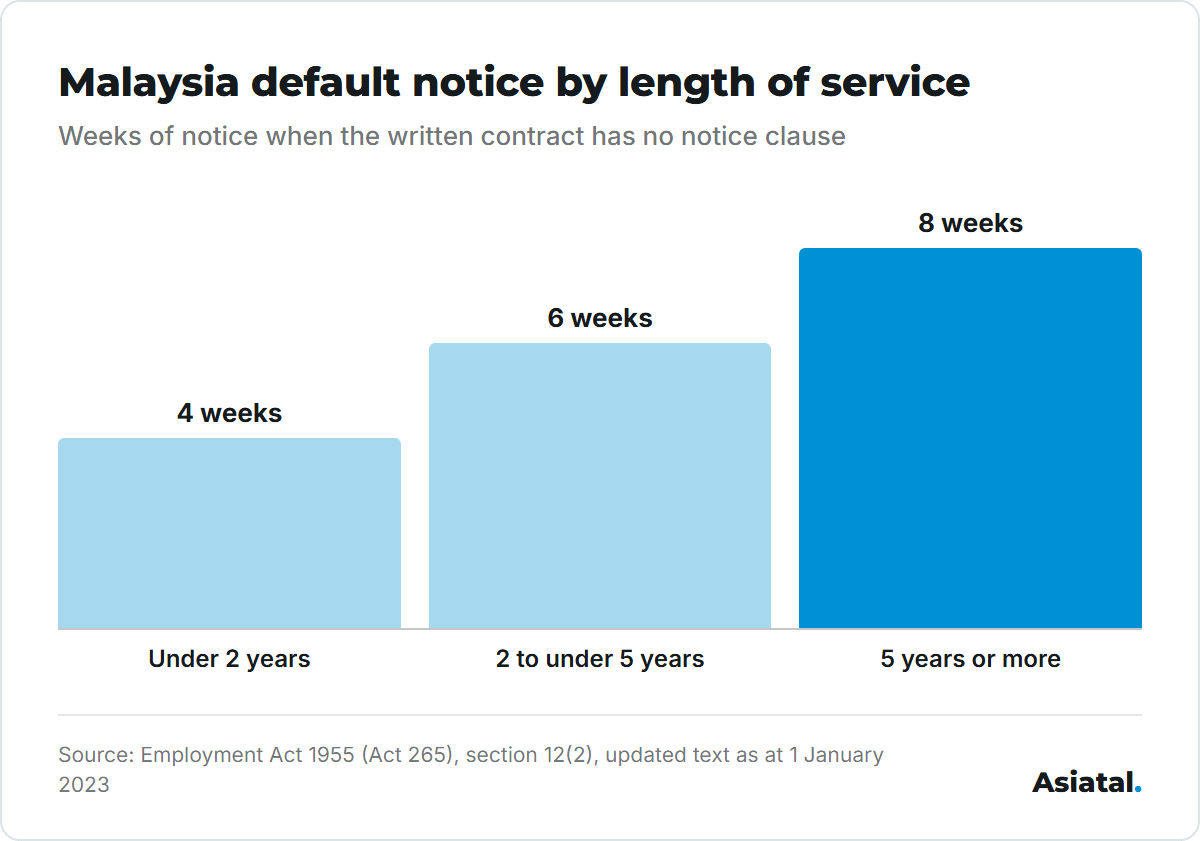
Three details in section 12 matter in practice:
- Notice must be in writing, and the day of the notice counts as part of the period.
- Either side can waive its right to notice.
- When a job ends because the business closes, moves, needs fewer people for that work, or changes owner, the statutory minimum applies whatever the contract says.
Section 13 is the buyout. Either side can end the contract without notice by paying an indemnity equal to the wages for the notice period, or for the part still to run. Section 14 lets an employer dismiss without notice for misconduct, but only after a due inquiry.
Since the Employment (Amendment) Act 2022 took effect on 1 January 2023, the Act covers anyone under a contract of service, whatever they earn.
For staff above RM4,000 a month, other than manual and similar workers, only a few pay subsections in sections 60 to 60D and the termination benefits in section 60J drop away. Section 12 notice still applies. For pay levels, see the Malaysia hiring page.
How a resignation notice pushes back a start date
Statutory notice is the shortest gap between a signed offer and a first day, unless the current employer agrees to let the candidate go sooner. A Vietnamese enterprise manager faces the longest statutory wait of the four markets.
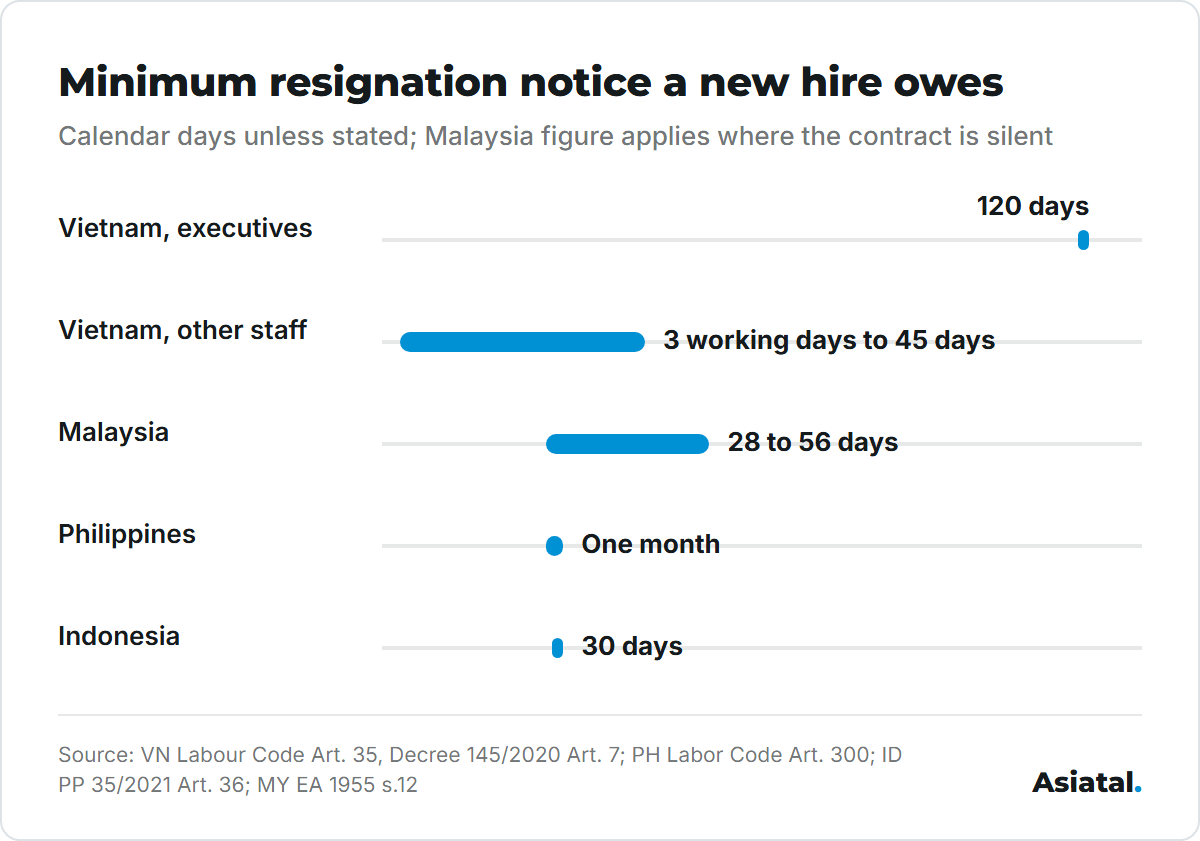
Each law handles an early exit in its own way:
- Vietnam: both parties can agree to end the contract (Article 34), a separate ground from a one-sided resignation under Article 35.
- Philippines: a candidate who leaves early risks a damages claim from the old employer (Article 300).
- Indonesia: PP 35/2021, Article 36, requires the employee to keep working until the date in the resignation request.
- Malaysia: the old employer can waive its right to notice, or the employee can pay the section 13 indemnity.
The notice period is one step in a longer hiring process in Southeast Asia, which also covers vetting and onboarding.
Rule changes since 2015 and the one still pending
Three of the four markets have changed these rules within the last six years, and Indonesia's next change has a deadline.
- 2015DOLE renumbers the Philippine Labor Code; probation moves from Article 281 to 296
- 1 Jan 2021Vietnam's Labour Code No. 45/2019/QH14 takes effect
- 2 Feb 2021Indonesia issues Government Regulation 35/2021
- 1 Jan 2023Malaysia's Employment (Amendment) Act 2022 takes effect
- 31 Mar 2023Indonesia enacts Law 6/2023 on Job Creation
- 31 Oct 2024Indonesia's Constitutional Court issues Decision 168/PUU-XXI/2023
- Feb 2026Vietnam publishes a consolidated Labour Code; probation and notice articles unchanged
- 27 Aug 2026Indonesia's parliament adopts the Employment Protection Bill as its initiative
- 31 Oct 2026Court deadline for Indonesia's new employment law
Malaysia's 2023 change widened who section 12 covers but did not alter the 4, 6 and 8 week periods.
Probation and notice terms when you hire through Asiatal
The Asiatal Retainer plan, a $499 monthly fee on top of the talent's pay, includes Employer of Record service, contracts tailored to local laws, managed payroll and ongoing local compliance. The probation clause and notice terms sit in that contract. Shortlists arrive in 5 business days, and the candidate's notice period runs on top of that.
Companies with their own payroll can use the Recruiting Partner option instead: a one-time fee of 15% of first-year salary, with a 90-day replacement guarantee. Details are on the pricing page and in how Asiatal works.
Frequently asked questions
When is final pay due after an employee leaves?
Vietnam requires both sides to settle within 14 working days, extendable to 30 days in listed cases such as a closure (Labour Code, Article 48). The Philippines allows 30 days under DOLE Labor Advisory 06-20. Malaysia requires earned wages by the last day of the contract (Employment Act, section 20). The payroll setup guide covers the rest of the final pay run.
Does the Employment Act 1955 cover Sabah and Sarawak?
No, section 1 applies the Act to Peninsular Malaysia, and an order extended it to Labuan from 1 November 2000. Sabah and Sarawak have their own laws: the Labour Ordinance (Sabah Cap. 67) and the Labour Ordinance (Sarawak Cap. 76).
Can an employee in Vietnam withdraw a resignation?
Yes, but only with the employer's agreement. Article 38 of the Labour Code lets either side withdraw a notice of termination in writing before the notice period ends, if the other side agrees.

 How to Set Up Payroll for a Remote Team in Southeast Asia
 The Cost to Hire Software Engineers in Southeast Asia (2026)
 How to Hire Remote Employees in Southeast Asia in 2026